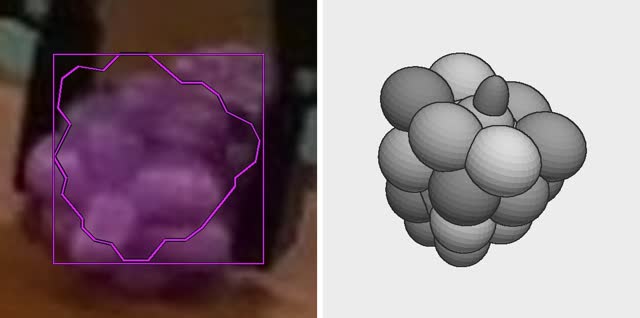
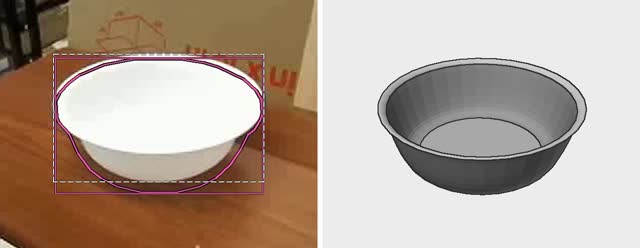
Each scene is one recorded robot episode. Left of the line is the real robot; right of it, its physics twin in Isaac Sim replays the same recorded actions. Point at a scene to move the line, click it for the full videos, and scroll sideways for more.
How it works
From one recorded demonstration to a physics scene that replays it. The robot arm itself aligns the cameras, and an agent runs each tool and checks the result before moving on. The steps play on their own; drag the scene to look around.
GPT-6 judge: accepted the real video left of the line, the replay right of it
grapesbowlDrag to turn, scroll to zoom
The steps play on their own.
Real-to-sim-to-real
The verified twin also gives a robot agent its context. From the replayed demonstration and the scene's measurements we write a demonstration context: the person's sequence as tool calls, and measured numbers relative to the objects. The agent (ORA) then runs the task twice on new layouts, once with the context and once without it; its model weights never change.
One real demonstration
A person teaches the task once on the SO-101 arm. 2× speed.
The verified twin
Its replay in simulation reproduces the demonstration. 2× speed.
Demonstration context
Grasp
3.1 cm above its bottom
Lift
straight up 7.0 cm
Release
1.3 cm above the opening
+ the person's sequence as tool calls
Demonstration context
Measured in the twin: what the agent reads, not new weights.
With the context
The agent reads the context and runs the task on a new real layout: both blocks in. Pauses cut, 4× speed.
Without the context
The same agent on a new real layout, without the context: no block goes in. Pauses cut, 4× speed.
The same task on the real SO-101 arm with a new layout, once with the context and once without; blue and orange blocks stand in for the green and red ones. One run each, so these are demonstrations, not success rates. Pauses are cut and the videos run at 4× speed.
✓ Success
With the contextBoth blocks are picked up and dropped through the opening: the blue one, then the orange one. 54 model calls, 26 min.
✕ No block in
Without the contextIt reaches for the blue block again and again and sets it back on the table, and never holds the orange one. No block goes in; the run was stopped after 47 model calls, 21.5 min.
Limitations
Our twins cover rigid objects and simple articulated objects, such as drawers. Soft bodies, such as towels and napkins, and complex articulated objects are left for future work.